Compare the Best Domain Registrars: Features and Pricing in 2026
Picking a domain registrar is a boring decision with expensive long-term consequences. A cheap first-year price can hide a renewal cliff. A “free website builder” bundle can make your DNS harder to move. And the wrong default settings can leave your brand exposed in WHOIS data.
In 2026, the public data still tells a simple story: the DNS industry is enormous, .com remains the default lingua franca for global brands, and registrar quality matters more than ever because migrations are painful once email, TLS, and SaaS integrations depend on your DNS.
Key Takeaways
- In 2026, DNIB’s Domain Name Industry Brief reported 392.5 million domain registrations across all TLDs, up 6.5% year over year (Business Wire, Verisign DNIB Q1 2026 announcement, 2026).
- Treat renewal price, transfer policy, and DNS portability as first-class requirements; introductory pricing is a marketing lever, not a forecast of total cost.
- If you want the clearest “no markup” retail model, Cloudflare documents that Registrar charges what registries and ICANN charge, with no markup and no surprise fees (Cloudflare, Cloudflare Registrar product documentation, retrieved 2026-05-06).
What Should You Compare First When Choosing a Domain Registrar in 2026?
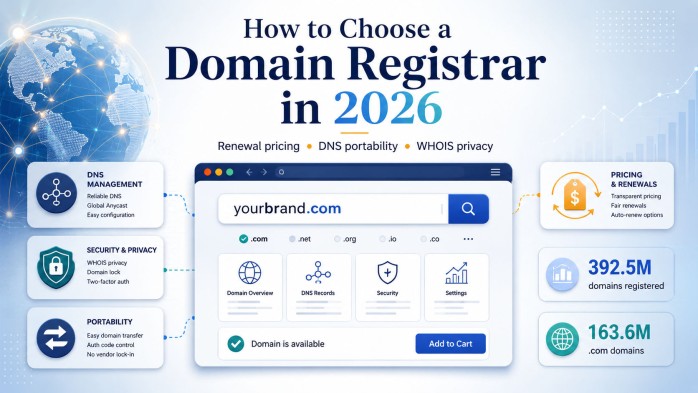
In 2026, DNIB’s quarterly industry brief—distributed via Verisign’s announcement—puts the global domain base at 392.5 million registrations across all TLDs (Business Wire, Verisign DNIB Q1 2026 announcement, 2026). That scale is why small differences in registrar behavior compound: a slightly worse DNS UX becomes a tax on every engineer who touches your stack.
Start with the “boring” items that affect ownership cost and risk:
- Renewal and transfer pricing (not just the first invoice)
- WHOIS privacy defaults and whether privacy is bundled or upsold
- DNS features (APIs, TTL controls, ALIAS/ANAME patterns, DNSSEC ergonomics)
- Account security (MFA, delegated access, recovery workflows)
- Exit friction (transfer locks, odd auth codes, slow support)
According to the same Q1 2026 DNIB figures, new .com and .net registrations totaled 11.5 million, compared with 10.1 million in Q1 2025 (Business Wire, Verisign DNIB Q1 2026 announcement, 2026). That growth is a useful gut check: demand is not collapsing, and registrars still compete aggressively on acquisition—sometimes to the detriment of clarity at renewal.
Our read of the market: the registrars that “win” for technical buyers in 2026 are rarely the loudest in ads. They are the ones that make renewals predictable, keep DNS edits safe, and avoid turning support into a sales funnel—because the cost of a bad registrar is paid in incident time, not in the $2 you saved on day one.
How Large Is the Domain Name Registration Market in Early 2026?
In 2026, the same Verisign-sponsored DNIB release states there were 176.1 million .com and .net registrations combined, including 163.6 million .com names and 12.4 million .net names. Country-code TLDs (ccTLDs) sat at 146.3 million registrations.
That split matters for buyers: .com still behaves like a default global brand TLD in many categories, while ccTLDs remain strong for local trust signals (and sometimes for pricing discipline).

If you are building a content or SaaS property, this is also where “strategy” meets procurement: your domain is an asset, and the registrar is the custody layer. If your org already standardizes vendor risk reviews, treat DNS providers and registrars as part of that same workflow.
How Do Registrar Pricing Models Differ in Practice?
In 2026, retail prices you see at checkout still sit on top of registry economics. Reporting around Verisign’s .com contract described a $10.26 wholesale price for an annual increment effective September 1, 2024, with registrars typically adding margin—while a smaller set aims to charge closer to wholesale (Domain Name Wire, .com prices go up at the end of the month, 2024). You should treat that number as a floor context, not your final invoice: ICANN fees and registrar policy still shape what you pay.
That is why “best price” comparisons that only screenshot the first year are misleading. The honest comparison is closer to a 3–5 year total cost of ownership model, including:
- renewal price
- transfer price (if you move)
- privacy (if billed separately)
- “gotchas” like mandatory bundles or aggressive upsells at checkout
Cloudflare’s own Registrar positioning is unusually explicit in documentation: it states customers are charged what is paid to the registry and that there is no markup and no surprise fees (Cloudflare, Cloudflare Registrar product documentation, retrieved 2026-05-06). Whether that is the best fit for you still depends on constraints (TLD support, DNS coupling, org workflows)—but it is a useful benchmark when evaluating everyone else.
If your finance team models multi-year spend, ask for the renewal quote in writing and compare it to the documented wholesale baseline discussion in trade reporting—then add ICANN fees and any paid privacy lines so you are not comparing apples to coupons.
Which Registrars Are Strong Options to Shortlist in 2026?
In 2026, the DNIB Q1 snapshot attributed 163.6 million registrations to .com alone—still the single largest slice of the 392.5 million TLD total cited in Verisign’s announcement (Business Wire, Verisign DNIB Q1 2026 announcement, 2026). That scale is why registrar UX still maps to “default choices”: most buyers want a name that is easy to spell, easy to trust, and easy to operationalize.
There is no single “best” registrar for every buyer. There is a best fit for your constraints: TLD list, team skills, compliance needs, and whether DNS must stay portable.
If your business is geographically anchored, your shortlist should include at least one registrar that handles your ccTLD cleanly—not every retailer optimizes every country code equally.
The table below is intentionally feature- and philosophy-oriented. Retail prices change with promotions; your checkout quote is the source of truth.
| Registrar | Best for | WHOIS / privacy posture (high level) | Notes worth verifying before you buy |
|---|---|---|---|
| Cloudflare Registrar | Teams already on Cloudflare who want documented “at cost” pricing | Redacted WHOIS documentation exists in Cloudflare’s registrar docs | You’re buying into Cloudflare nameserver assumptions—read their registrar restrictions carefully (Cloudflare, Register a new domain, retrieved 2026-05-06) |
| Porkbun | Straightforward UX, strong reputation among technical buyers | Commonly recommended for inclusive privacy features (confirm per TLD) | Great when you want a calm checkout without theatrical upsells |
| Namecheap | Broad TLD catalog and familiar control panel | Often cited as competitive on bundled privacy (confirm per TLD) | Watch renewal emails and auto-renew settings like any large retailer |
| NameSilo | Price-conscious portfolio holders | Privacy positioning is a selling point (confirm current policy) | API and bulk workflows matter more than “pretty” |
| GoDaddy | Buyers who want auctions, brokerage-adjacent services, and phone support | Privacy is often productized—verify what is included | Read renewal and add-on cart behavior slowly |
| AWS Route 53 Domains | AWS-centric orgs standardizing on one cloud bill | Check current AWS docs for privacy/redaction behavior | Great for IAM-minded teams; less “small business friendly” UX |
| Squarespace Domains | Teams consolidated after portfolio migrations | Verify privacy and billing settings in current Squarespace docs | If you landed here via acquisition, validate DNS portability early |
If you are comparing “ecosystem bundles” (domain + site builder + email), read the fine print on whether the domain can move cleanly. Bundles can be fine—they can also become lock-in if DNS control is inconvenient.
Are .com and .net Domains Still Growing?
In 2026, the DNIB-derived figures show .com and .net combined grew 3.7% year over year in the domain name base. That is not a prediction about your niche—it is a reminder that the “default” TLD still carries network effects in trust and memorability.

If you are choosing between .com and a clever new gTLD, decide based on memorability, spoofing risk, and email deliverability perceptions—not on novelty alone.
What Should You Do Before You Click “Buy”?
In 2026, DNIB cited 11.5 million new .com and .net registrations in Q1—up from 10.1 million in the year-earlier quarter. Busy buyers respond to that demand with impulse purchases; patient buyers respond with a three-minute renewal audit.
The market is big enough that mediocre registrars can still capture revenue. Your job is to avoid paying for confusion.
Sharp edge: registrars that look “expensive” on day one sometimes win on hours not lost—especially when a DNS mistake becomes customer-visible downtime.
A tight final checklist:
- Confirm renewal price and whether it auto-changes after promotions.
- Confirm privacy is included—or budget it explicitly.
- Export a DNS snapshot before major changes.
- Turn on MFA on the registrar account; treat it like a production system.
- Decide who owns the domain legally (founder personal email vs company account).
If you want a companion piece for brand protection, link it internally where you keep policy docs: [INTERNAL-LINK: trademark and domain monitoring basics → internal brand protection primer].
Frequently Asked Questions
What is the global domain registration count in 2026?
In 2026, DNIB reported 392.5 million domain registrations across all TLDs at the end of Q1, an increase of 6.5% year over year. Use that figure as macro context, not as a forecast for any single TLD’s branding power.
How many .com domains are registered?
In 2026, Verisign’s DNIB materials cited 163.6 million .com registrations as of March 31, 2026. That scale is why .com still behaves like a default in many markets.
Why do registrar prices differ if the registry fee is public knowledge?
In 2024, reporting on Verisign’s .com pricing described a $10.26 wholesale annual increment effective September 1, 2024, with many registrars adding margin. Retail invoices also include ICANN fees and business-model choices like promotions, bundles, and support costs.
Is Cloudflare always the cheapest domain registrar?
Not necessarily “cheapest in every TLD,” but Cloudflare documents a specific model: no markup beyond registry and ICANN charges, with no surprise fees. Your cheapest path can still depend on promotions elsewhere—compare renewals, not hero pricing.
Did .com and .net growth accelerate recently?
In 2026, DNIB cited 11.5 million new .com and .net registrations in Q1 2026 versus 10.1 million in Q1 2025. That is a demand signal, not a guarantee of availability for your favorite name.
Conclusion
If you remember nothing else, remember the two numbers that anchor reality in 2026: the industry is operating at 392.5 million registered domains, and .com alone is 163.6 million names in the DNIB Q1 snapshot. Inside that giant pool, your decision is still personal: pick the registrar that makes renewals honest, DNS edits safe, and exits possible.
When you publish, replace the internal link placeholders with real URLs from your site map, then run your usual editorial pass for brand voice.