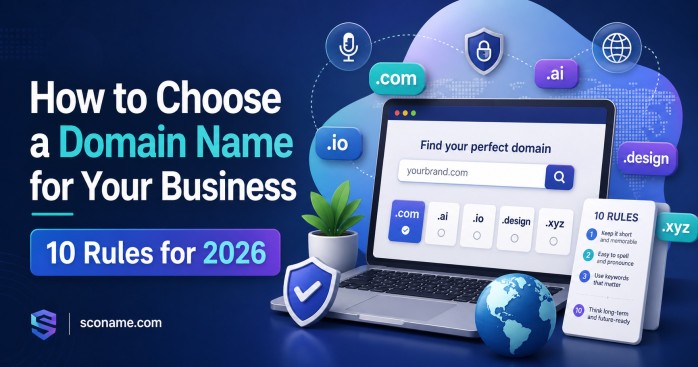
How to Choose a Domain Name for Your Business: 10 Rules for 2026
The digital landscape of 2026 looks vastly different than it did a decade ago. The "Gold Rush" for .com addresses has matured into a sophisticated market where relevance, brandability, and tech-alignment outweigh the traditional prestige of a legacy extension.
As we navigate a web driven by AI, decentralized apps, and niche communities, your domain name is no longer just a digital address—it is the cornerstone of your brand’s identity. If you are launching a venture today, here are the 10 golden rules for choosing a domain name that will stand the test of time.
1. Prioritize "Brandability" over SEO Keywords
The days of "best-affordable-marketing-tools-online.com" are over. Search engines have evolved to prioritize brand authority over exact-match domains. In 2026, your domain should be a unique vessel for your brand. Think of names like Airbnb, Loom, or Vercel. They are short, memorable, and don’t box the company into a specific product category.
2. Embrace the TLD Shift: .ai and .io are the New Standard
While .com remains the "real estate" of the web, it is no longer the only premium option. For tech, SaaS, and intelligence-driven companies, .ai and .io have become high-status indicators.
-
.ai: Originally a country code for Anguilla, it is now the definitive home for the artificial intelligence industry.
-
.io: Favored by developers and startups for its "Input/Output" connotation.
Choosing these tells your audience exactly what sector you inhabit before they even click the link.
3. Explore Niche TLDs for Specificity
2026 is the year of the niche. If you are a design agency, .design is often more impactful than a convoluted .com. If you run a community, .xyz or .community offers a modern, forward-thinking vibe. These Top-Level Domains (TLDs) allow you to get a shorter, punchier name that would be millions of dollars in the .com market.
4. The "Radio Test" is Non-Negotiable
With the rise of voice search and AI assistants (like Alexa, Siri, and specialized business agents), your domain must be easy to say and hear. If you have to spell it out ("It’s ‘Cat’ with a ‘K’ and two ‘Zs’"), you’ve already lost. If a user can’t type it correctly after hearing it once, the name is too complex.
5. Avoid the "Hyphen Trap" and Numbers
Hyphens and numbers are the hallmarks of early 2000s spam. They make a URL look cluttered and are difficult to communicate verbally. In an era where mobile browsing is the default, every extra character increases the friction for the user. Keep it clean: alphabetic characters only.
6. Keep it Under 12 Characters
Brevity is the soul of a good domain. Short domains are easier to remember, take up less space on social media bios, and look better on physical branding. Aim for two to three syllables. If your business name is long, consider a shortened version for your domain (e.g., National Geographic uses natgeo.com).
7. Think "Global-First" (Unless You Aren't)
If your business is strictly local (like a bakery in London), a .co.uk or .nyc extension provides immediate geographic trust. However, if you have any ambition for global scale, stick to "Generic" TLDs like .com, .net, or the tech-centric .ai to avoid being pigeonholed into one region.
8. Research Trademarks and Social Handles
Before you fall in love with a domain, check for existing trademarks. In 2026, legal battles over digital identity are more common than ever. Additionally, ensure the matching handles are available on platforms like X, LinkedIn, and Instagram. A cohesive brand identity across the web is vital for trust.
9. Use AI to Brainstorm, but Humans to Decide
LLMs are incredible tools for generating hundreds of domain variations based on your brand values. Use AI to find synonyms, metaphors, and creative linguistic blends. However, always run the final selection by a human focus group to ensure there are no unintended meanings or cultural faux pas.
10. Secure the "Defense" Domains
If you manage to snag a great .ai or .io domain, consider also purchasing the .com or .net versions if they are affordable. This prevents "typo-squatting" and ensures that competitors don’t siphon off your traffic. You can simply redirect these secondary domains to your primary site.
Final Thoughts
Choosing a domain in 2026 is about balancing tradition with innovation. While the .com extension still carries a legacy of trust, the modern user is more interested in the relevance of the extension to the service provided. Whether you go with a classic .com or a cutting-edge .ai, ensure your choice is short, speakable, and uniquely yours.
For more insights on digital branding and domain strategy, visit us at sconame.com.
Frequently Asked Questions (FAQ)
Q: Is .com still the best extension for SEO?
A: Not necessarily. Google has confirmed that using a new TLD (like .tech or .app) does not inherently hurt your search rankings. SEO is driven by content quality and backlinks; the extension is more about brand perception and click-through rates.
Q: Why are .ai domains so much more expensive than .com?
A: .ai domains have a higher wholesale cost set by the registry (Anguilla), and because of the massive AI boom, demand has skyrocketed. They are seen as premium "digital real estate" for the tech industry.
Q: Should I buy a domain from a reseller or a registrar?
A: If the domain you want is "parked" or owned by someone else, you’ll need to go through a reseller or broker. If it’s available for new registration, always use a reputable registrar like Sconame to ensure you get the best price and full ownership rights.
Q: Can I change my domain name later?
A: You can, but it is a complex process. It involves setting up 301 redirects to maintain your SEO authority and rebranding all your marketing materials. It is much better to invest the time to choose the right name from the start.
Q: What is a "Niche TLD"?
A: A Niche TLD (Top-Level Domain) is an extension specific to an industry or interest, such as .photography, .estate, .guru, or .crypto. These are great for making your URL descriptive and memorable.